Yves Schmidt · 28 September 2026
National Funding Programs Bridge Laser Spectroscopy Research with Quantum Entanglement Testing and Eco-Conscious Optics Production
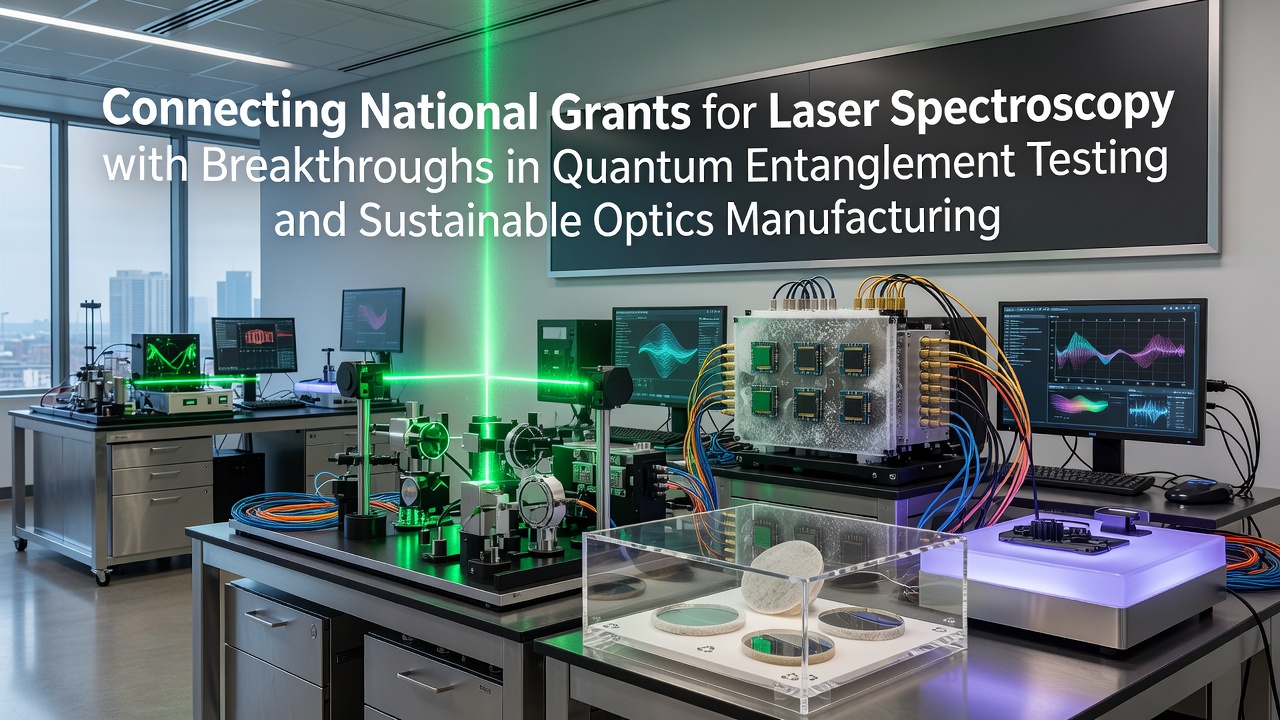
National funding initiatives have increasingly supported laser spectroscopy projects that intersect with quantum entanglement testing and sustainable manufacturing practices in optics. These programs allocate resources across multiple countries, creating pathways where spectroscopic techniques help verify entangled states while manufacturers adopt greener production methods for optical components. Data from various agencies shows steady growth in cross-disciplinary grants since the early 2020s, with particular emphasis on projects that combine precision measurement tools and environmental considerations. Researchers at several institutions have used grant support to refine laser-based methods for probing quantum systems. Spectroscopy allows detailed analysis of atomic and molecular interactions, which proves essential when confirming entanglement properties in controlled experiments. Grants often prioritize equipment upgrades that improve resolution and stability, enabling teams to conduct tests that were previously limited by hardware constraints. In one documented case, a European consortium integrated spectroscopic diagnostics directly into entanglement setups, reducing measurement times and increasing data reliability.Grant Structures and Their Role in Research Integration
Public funding bodies design grant frameworks that encourage collaboration between spectroscopy specialists and quantum physicists. These structures typically require proposals to address both technical advancement and practical applications, such as scalable testing protocols. Funding rounds often include criteria for sustainability, pushing teams to consider material sourcing and waste reduction from the outset. Observers note that this approach has led to shared facilities where spectroscopy labs support entanglement work while also exploring low-impact fabrication techniques for lenses and mirrors.
September 2026 marks the start of a new multi-year funding cycle in several regions, with announcements expected to highlight joint calls for proposals that explicitly link these fields. Agencies have signaled interest in projects that demonstrate measurable progress in entanglement verification alongside reduced environmental footprints in optics production. This timing aligns with broader policy shifts toward integrated research agendas that avoid siloed funding streams.
Advances in Quantum Entanglement Testing Through Spectroscopic Tools
Breakthroughs in entanglement testing have relied on laser spectroscopy to achieve higher fidelity measurements. Teams apply tunable lasers to excite specific transitions in atoms or ions, then analyze emitted or absorbed light to extract information about quantum correlations. Such methods complement traditional detection schemes by providing non-destructive insights into system behavior. Research indicates that spectroscopy-enhanced protocols have improved entanglement distribution rates in fiber-based networks and trapped-ion platforms alike.
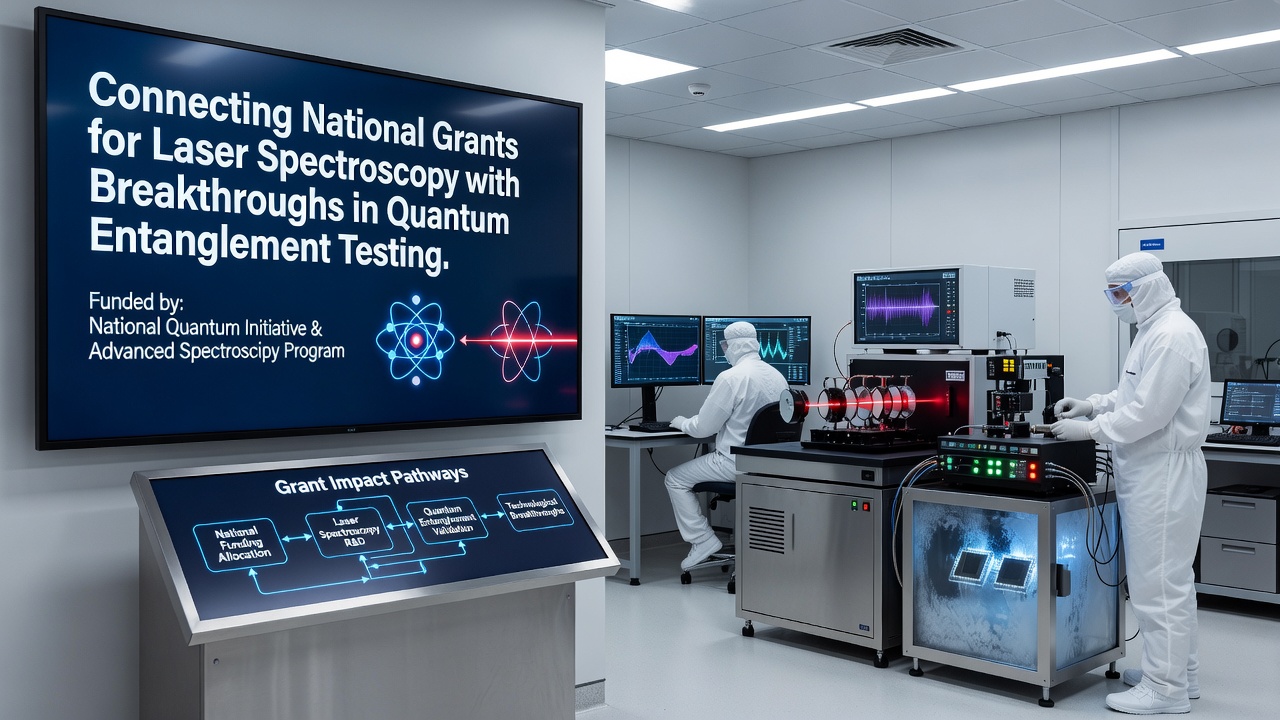
Studies funded through national programs have reported success in using spectroscopic feedback to stabilize entangled states over longer durations. This stability matters for applications ranging from secure communication to distributed sensing. Data shows that integrating real-time spectral monitoring reduces error rates during state preparation and verification steps. Those who have examined the results point to consistent improvements when grants support both the spectroscopic instrumentation and the quantum hardware in coordinated efforts.
Sustainable Practices in Optics Manufacturing
Manufacturers have adopted sustainable approaches in response to grant requirements that tie funding to environmental metrics. These practices include closed-loop recycling of optical glass, energy-efficient polishing systems, and solvent-free coating processes. Spectroscopy plays a supporting role here as well, since quality control measurements help maintain performance standards while minimizing material waste. Reports from industry groups document lower carbon outputs in facilities that combine spectroscopic inspection with updated production lines.
National programs have funded pilot lines that demonstrate these methods at scale. One project tracked reductions in water usage and chemical byproducts through spectroscopic monitoring of process streams. The same techniques that aid quantum testing also verify coating uniformity and substrate purity, creating dual-use value for the equipment. Observers have recorded that such overlap encourages manufacturers to invest in versatile tools rather than specialized single-purpose systems.
Connecting the Elements Through Coordinated Funding
The linkage between grants, spectroscopy, entanglement testing, and sustainable manufacturing emerges most clearly in collaborative networks. Universities partner with national laboratories and private firms to share resources and data. This model allows spectroscopic expertise developed for quantum applications to transfer into manufacturing quality assurance, while sustainability goals influence equipment choices across both domains. Evidence from funded projects reveals faster iteration cycles when teams address all three areas within single grant proposals.
External evaluations of these programs, including those referenced by the Natural Sciences and Engineering Research Council of Canada, highlight measurable outputs in both scientific publications and process patents. Similar patterns appear in reports from the European Research Council, where cross-theme funding has supported optics projects that span quantum and environmental objectives. These connections continue to shape how resources are distributed and how progress is tracked across the fields.
Conclusion
National grants have established concrete connections among laser spectroscopy advancements, quantum entanglement testing improvements, and sustainable optics manufacturing. The resulting projects demonstrate integrated progress where measurement techniques serve multiple purposes and environmental considerations influence research design from the beginning. Ongoing funding cycles, including those launching in September 2026, are expected to build on these foundations with continued emphasis on shared tools and collaborative structures.