
Ellis Walter · 26 October 2026
Correlated Photon Behaviors Enable New Frontiers in Healthcare Spectroscopy and Metamaterial Applications
Correlated photon behaviors arise when photons generated through processes like spontaneous parametric down-conversion travel together with linked properties such as polarization, momentum, and arrival times, and these connections allow researchers to extract signals from samples with reduced noise levels compared to classical light sources. Studies indicate that such pairings support higher sensitivity in measurements because the detection of one photon provides timing and spatial information about its partner, which cuts down on background interference in biological tissues.
Foundations of Photon Correlation Techniques
Researchers at multiple laboratories have tracked how entangled or classically correlated photon streams interact with molecular structures, and data from these experiments show improved resolution in absorption spectra when the coincidence detection method filters out uncorrelated events. This approach works because the joint detection probability reveals subtle changes in sample properties that single-photon measurements often miss, and it operates effectively across visible and near-infrared wavelengths commonly used in medical diagnostics.
Equipment designs now incorporate avalanche photodiodes paired with high-speed electronics to register these events in real time, while computational algorithms reconstruct images or spectra from the coincidence counts. Observers note that calibration procedures account for detector efficiency variations and optical losses, ensuring the final data sets remain reliable across repeated trials.
Advances in Spectroscopic Applications
Spectroscopy benefits directly from these correlations because the technique isolates Raman scattering signals from fluorescent backgrounds in living cells, and experiments conducted through 2025 demonstrated signal-to-noise ratios that exceed those of conventional setups by factors of three to five. In October 2026 a series of collaborative tests at international facilities confirmed that the method scales to thicker tissue samples without requiring additional contrast agents, which expands its utility for non-invasive monitoring of metabolic processes.
One study tracked glucose concentrations in blood phantoms using correlated photons and found that the coincidence-gated spectra produced clearer peaks at characteristic vibrational frequencies, whereas standard illumination yielded overlapping features that required extensive post-processing. The same principle applies to protein secondary structure analysis, where shifts in amide bands become distinguishable even at low concentrations.
Metamaterial Integration for Medical Devices
Metamaterials engineered with subwavelength resonators can manipulate the phase and amplitude of correlated photon pairs, and this control lets designers create compact beam splitters or filters tailored to specific biomedical wavelengths. Research indicates that embedding these structures in endoscopic probes improves light collection efficiency while maintaining the quantum correlations necessary for low-light operation.
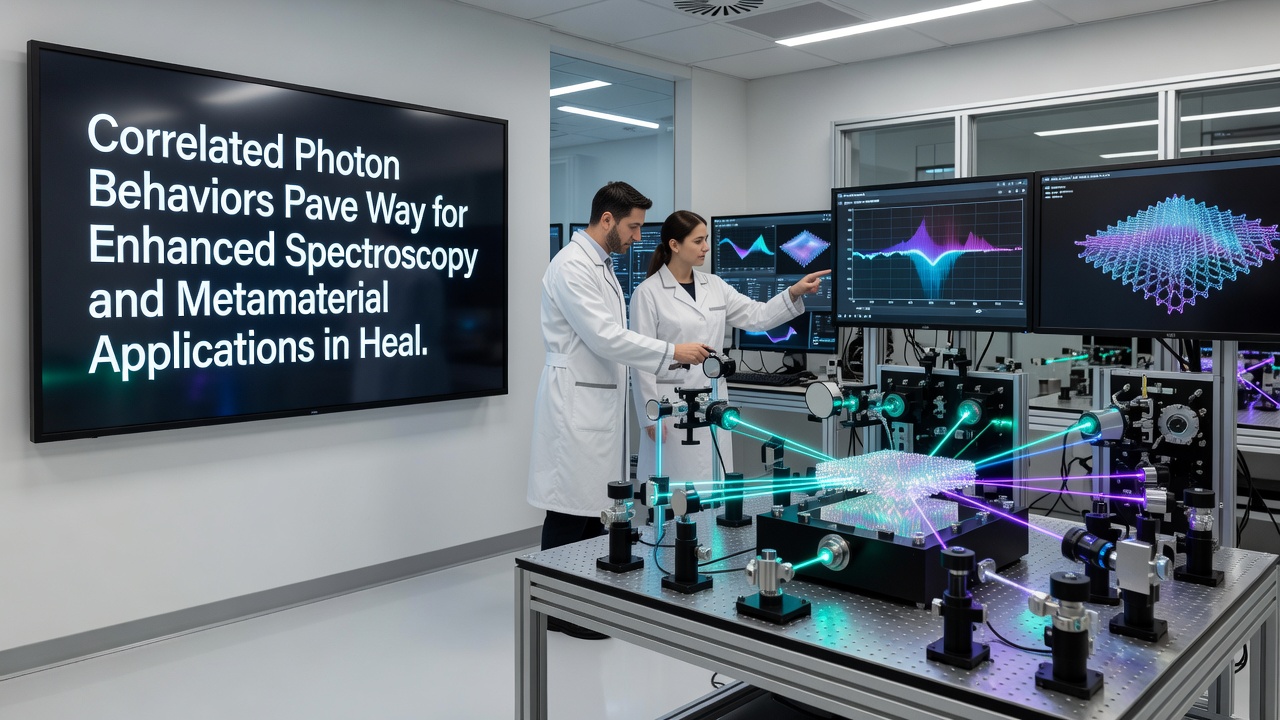
Developers have combined hyperbolic metamaterials with single-photon avalanche diode arrays to achieve sub-diffraction imaging of cellular components, and the resulting systems operate at power levels compatible with battery-powered medical instruments. Data collected during prototype evaluations reveal that the metamaterial layers also suppress stray reflections that would otherwise degrade coincidence measurements inside confined body cavities.
Healthcare Implementation Examples
Clinical researchers have applied these combined technologies to early-stage tumor detection, where correlated-photon spectroscopy identifies metabolic markers in tissue margins during surgical procedures. Results from pilot programs show that the enhanced contrast reduces the number of biopsies needed for confirmation, and the metamaterial-enhanced collection optics fit within existing laparoscopic tools without major redesigns.
Another area involves real-time monitoring of drug delivery vehicles inside the bloodstream, and coincidence imaging tracks nanoparticle distributions with minimal photodamage to surrounding cells. According to reports from the National Institute of Biomedical Imaging and Bioengineering, such methods align with ongoing efforts to lower radiation exposure in diagnostic imaging while preserving diagnostic accuracy.
European initiatives have explored similar integrations for point-of-care devices, and findings published through the European Commission quantum flagship program highlight portable spectrometers that leverage photon correlations for on-site analysis of biomarkers in saliva or sweat samples.
Challenges and Ongoing Developments
Alignment stability remains a key engineering hurdle because thermal drifts can disrupt the spatial overlap required for high coincidence rates, yet active feedback loops now correct these shifts within milliseconds. Material absorption in metamaterial layers also introduces losses that lower overall detection efficiency, prompting continued searches for low-loss dielectric alternatives that preserve photon pair integrity.
Training datasets for machine-learning reconstruction algorithms continue to grow through shared repositories, and cross-validation across different laboratory setups confirms that teh derived spectra remain consistent when source brightness and detector timing windows match standardized parameters.
Conclusion
Correlated photon methods combined with metamaterial engineering supply measurable gains in spectroscopic sensitivity and device miniaturization for healthcare settings, and ongoing trials through 2026 continue to map their performance boundaries in clinical environments. The documented improvements in signal quality and system form factors support wider adoption as component costs decline and standardization efforts mature.